

Engineering CMS Platforms for AI Visibility
- Andy Wood
- Renegade Agency
Structured content, governed workflows and embedded AI for brand visibility at scale.
This three-part series explores the impact of AI on brand discovery and what you can do to regain control.
How people are starting to rely on AI to make choices for them, and why that means some brands get recommended, while others get ignored.
2. How content operations must evolve
Why the way organisations create and manage content needs to change, so AI can understand, trust, and include your brand in decisions.
3. Engineering CMS platforms for AI visibility (this article)
How content is structured, managed and created, using your CMS so your brand shows up consistently when AI is making recommendations.
Engineering Trust
Regaining control of how AI sees and interprets your brand isn’t a front-end problem, it has to be engineered inside your content system (CMS).
That means focusing on four things:
- Content structure → how information is modelled and defined
- Governance → how consistency and control are enforced
- Workflow design → how content is created and maintained
- Scalable enablement → how capability is built across teams
This is a shift away from web pages, campaigns, and surface-level experiences, towards the underlying system that define how your brand is understood.
This is because AI doesn’t experience your brand, it interprets based on structured trust signals.
That interpretation is dependent on whether or not your CMS provides:
- Structured, explicit information
- Consistent signals across markets
- Governed, trustworthy content
Get this right, and AI can understand and trust your brand. Get it wrong, and AI moves on to your competitor.
AI Doesn’t Read Your Website
This is one of the most important shifts to understand.
AI doesn’t read pages the way humans do, it extracts, compares and decides.
What AI systems are looking for is explicit, structured information:
- product attributes
- structured pricing
- clear policies
- named entities
- defined relationships
These are the signals AI uses to understand what you offer, compare you to competitors, and decide whether to recommend your brand
If your content is written as long-form copy with implicit meaning, AI struggles. If it’s structured and modelled, AI understands.
Here’s an example of what AI Systems extract from content to form a recommendation:
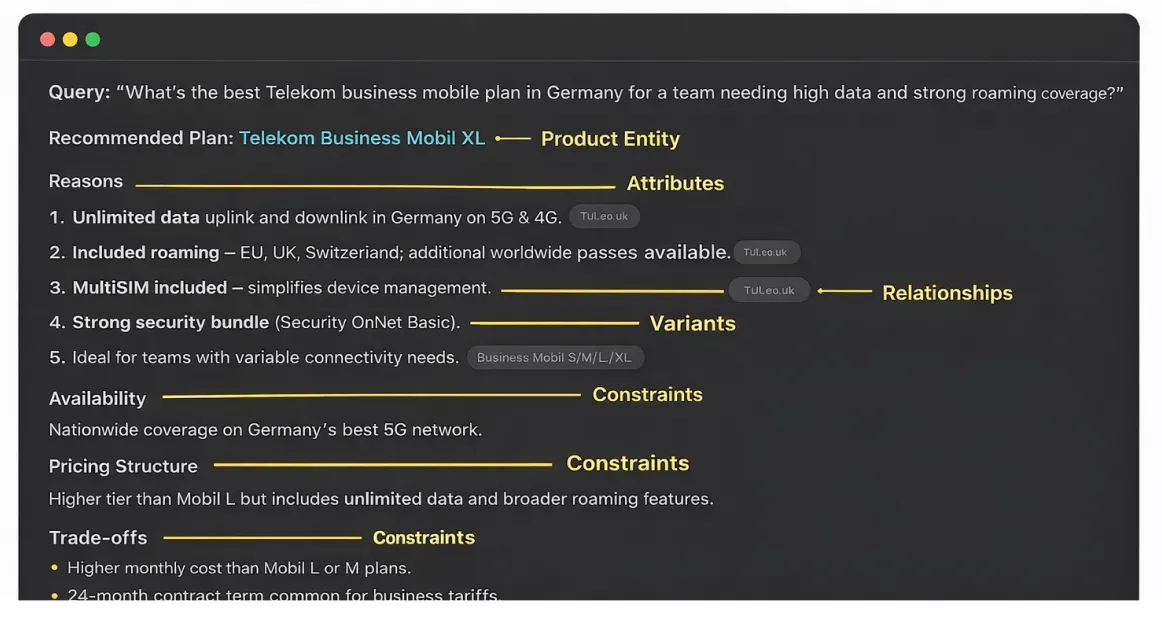
AI visibility is not about optimising pages, it’s about designing content so it can be interpreted, compared and trusted.
AI visibility is not SEO, it’s content architecture.
What AI-Ready Content Actually Looks Like
AI doesn’t evaluate brands emotionally, it evaluates signals.
Inside the CMS, this means defined content models, controlled vocabularies, explicit fields, structured components, and governed taxonomies.
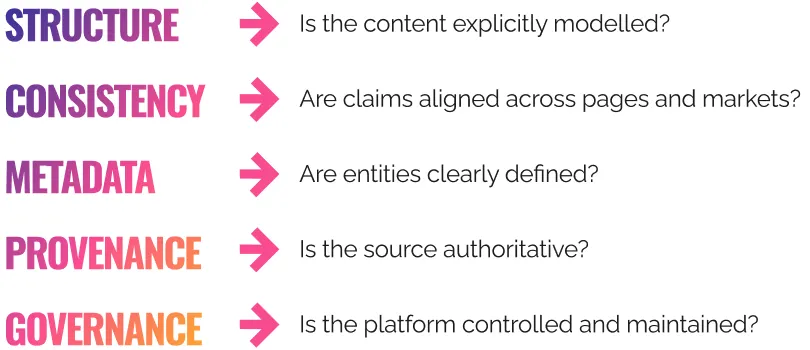
These are not campaign signals, they’re CMS signals. It’s not a content exercise, it’s system design and engineering.
Content modelling is a strategic capability. It defines not just how content is published, but how your brand is understood, compared and chosen by AI.
AI visibility isn’t something you casually optimise after publication. It’s core strategic engineering at the point of creation.
Engineering AI-ready Content
Take a typical product or service page.
In many organisations it looks like this:
- Long-form copy
- Implicit claims
- Buried policies
- Unstructured attributes
AI struggles with this.
Making content AI-ready means restructuring it inside the CMS. Not rewriting it, but redefining how it’s stored and expressed.
You’re not just “cleaning content”, you’re changing its form. Attributes become fields, policies become components, features align to taxonomy, and entities are clearly defined.
Instead of focusing only on web page paragraphs, content also becomes a set of explicit, structured components:
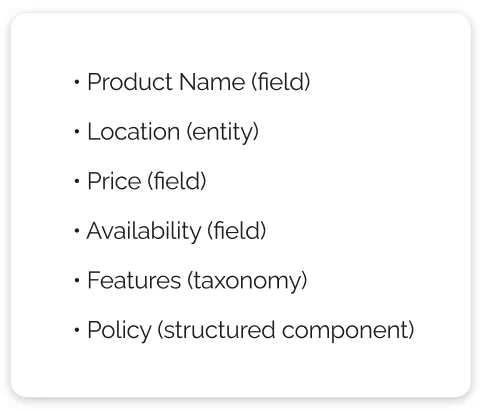
Doing this work means AI can now:
- Extract meaning from your brand
- Compare values across your content and with others
- Validate for trust and consistency
This is different from SEO optimisation, it’s Content Model Design.
It’s how AI moves from reading your content, to making decisions about your brand.
Why SEO and Accessibility Still Matter
SEO and accessibility haven’t disappeared, but they have changed role.
Both improve machine interpretability, a critical factor in AI visibility.
Accessibility forces structure: with proper headings, descriptive links and semantic navigation.
SEO enforces clarity: with explicit subjects, defined hierarchy and intent alignment.
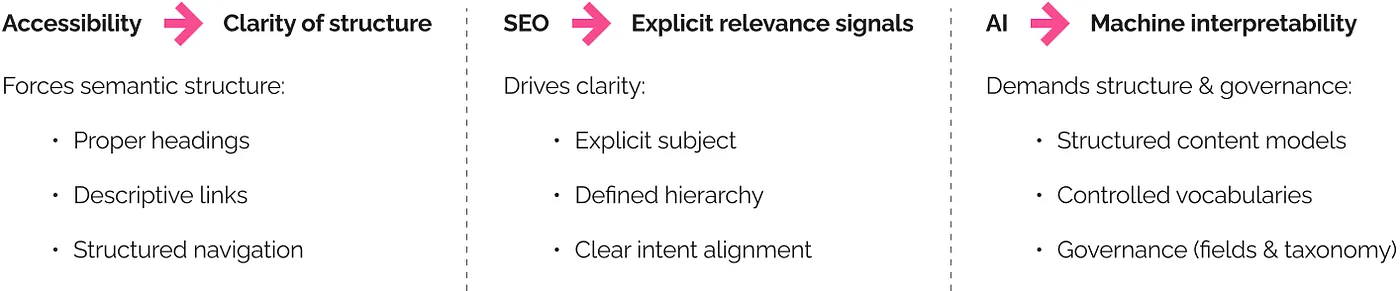
In the AI era: Accessibility and SEO become AI readiness disciplines.
Scale Needs AI-Augmented Workflows
At enterprise scale, content is never static, it’s constantly created, updated, translated, reused and adapted.
Each change across markets, teams, brands and channels introduces variation, and variation creates risk.
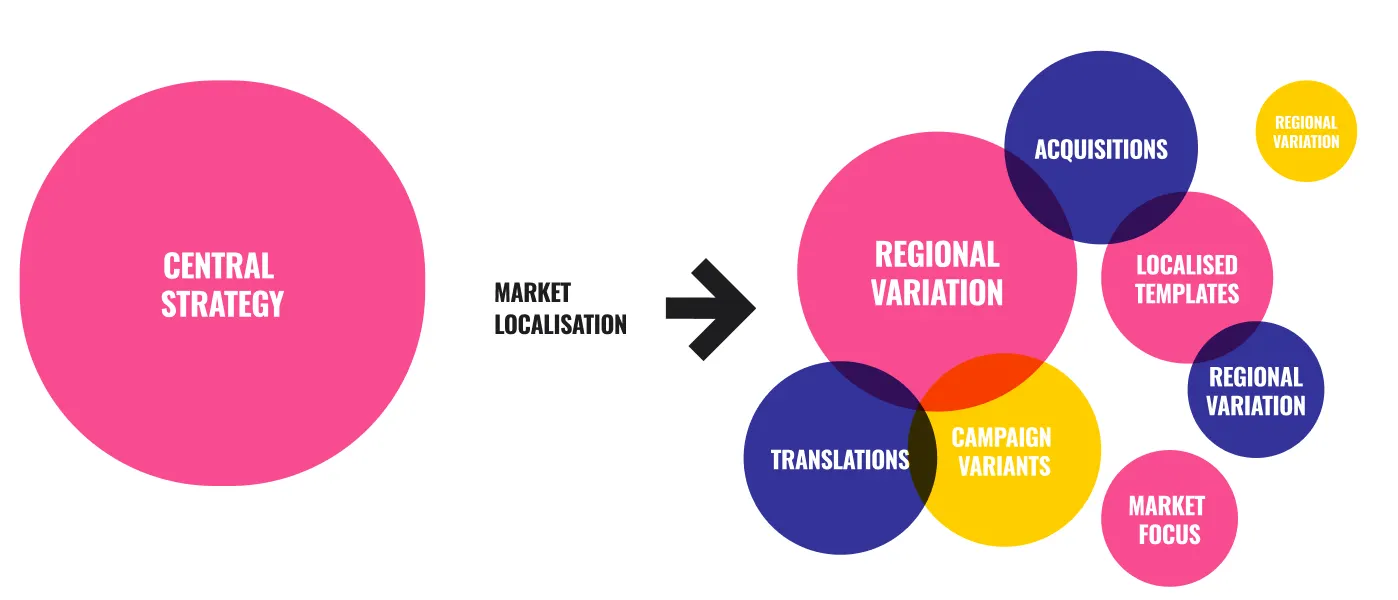
This is the reality behind most global content ecosystems: acentral strategy, fragmented through localisation, campaigns, translations and regional needs.
Which creates two core challenges:
- Initial engineering effort: structuring content models, defining entities, aligning taxonomy
- Ongoing scale management: maintaining consistency, governance and quality across the ecosystem
The reality today is that most organisations are still operating with workflows designed for publishing, not control:
- Metadata varies from market to market
- Brand guidelines sit in PDFs, not in the CMS
- Accessibility is treated as a periodic audit
- SEO is applied after content is written
In a human-first internet, this was manageable, but in an AI-mediated one, it isn’t.
This level of complexity is not something humans can reliably manage alone.
Which is why we look to AI enabled content workflows to add an augmentation layer that supports and scales human operations.
Redesign Your Content Workflows
This means actively redesigning how content is created, managed and governed.
Not as a layer on top, but as a structural change inside the workflow itself.
The redesign is foundational:
- Content models define what can be said
- Authoring enforces the structure
- AI tools operate within governed constraints
- Compliance checkpoints remain intact.
- Humans gateways review, refine and approve.
This ensures AI isn’t just bolted on, it’s designed into the workflow from the ground up.
AI at the Point of Creation:
This changes how teams work day-to-day. An editor might use a CMS-native AI tool to:
- Suggest missing metadata
- Flag inconsistencies across markets
- Check tone of voice against brand rules
- Validate accessibility and SEO requirements in real time
These tools are applied not after publication, but at the point of creation.
Managing complexity at scale:
This is where AI adds real value, supporting teams to manage complex ecosystems of markets, brands and channels, helping them:
- Enforcing structure
- Maintaining consistency
- Validating compliance
- Improving quality continuously
This shift moves from Content Management workflows designed for publishing, to Content Operations designed for AI interpretation at scale.
Without this tooling, the efficiency and consistency needed to control an international brand is difficult to maintain.
Controlled Enablement with Real Teams
So how do you actually implement this?
We use an agile Proof of Value method for controlled, iterative enablement.
Start with a single use case:
Week 1 → define the opportunity
Weeks 2–4 → redesign workflows inside the CMS
Weeks 5–6 → measure, refine, document
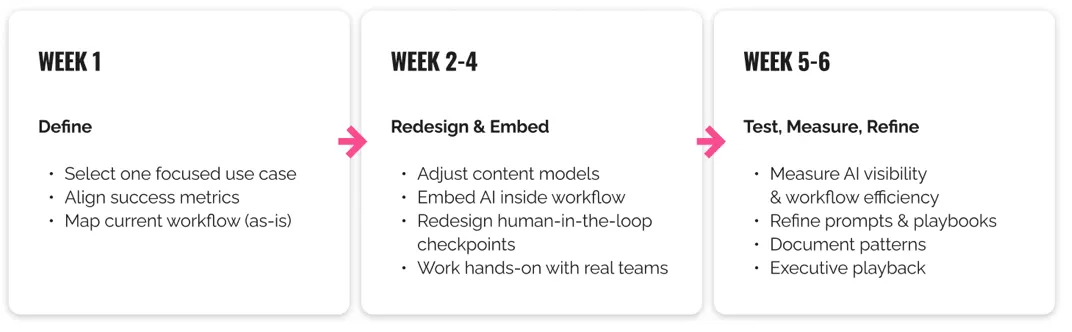
The approach is controlled, cost-defined, outcome-driven, and most importantly it builds real world momentum with teams. Teams build experience, and confidence with AI augmentation inside real workflows and within real governance constraints.
At the same time, organisations build:
- Prompt libraries
- Workflow playbooks
- Structured patterns
- Reusable models
This becomes an internal knowledge system for AI enablement of your Content Operation, which can then be used to scale across the organisation.
Validated use cases become patterns.
Patterns become playbooks.
Playbooks scale across teams.
Markets and brands, constantly build momentum and capability.
Final Thought
The biggest misconception about AI visibility is that it’s a surface problem, something to optimise after the fact.
In reality AI visibility is:
- Engineered in the CMS with structured content models
- Supported with schema and metadata
- Sustained through intelligent workflows
- Maintained with governance
AI Visibility isn’t created at the interface layer, it’s determined through the structure behind it.
Regaining control of your brand in AI-mediated discovery tomorrow means modernizing your Content Operations today.
This three-part series explores the impact of AI on brand discovery and what you can do to regain control.
1. How AI is reshaping brand discovery
How people are starting to rely on AI to make choices for them, and why that means some brands get recommended, while others get ignored.
2. How content operations must evolve
Why the way organisations create and manage content needs to change, so AI can understand, trust, and include your brand in decisions.
3. Engineering CMS platforms for AI visibility (this article)
How content is structured, managed and created, using your CMS so your brand shows up consistently when AI is making recommendations.

Andy Wood
Strategy Lead
Three decades of experience helping organisations navigate major technology shifts.
I can help you:
• Deliver next-generation digital experiences for customers
• Understand AI across business operations & customer experience
• Align enterprise technologies with operational & strategic goals