

Agentic commerce:
from “help me choose” to “go ahead and book it”
The buying journey is becoming a conversation with AI. Connecting it to a completed purchase is the next step.
- Renegade Agency
- Andy Wood
Let’s take planning and booking a trip as an example. Like many of you, I use ChatGPT and Claude to help plan my travel. Recent examples include sightseeing in Rome with my daughter and a wedding anniversary getaway to Brighton.
Travel is a good test of these tools. You’re making several connected decisions: where to stay, what to do, how far things are apart, what everything costs, and whether you’ll actually enjoy the itinerary.
An AI assistant saves a lot of browsing time. More importantly, it lets you explore through conversation.
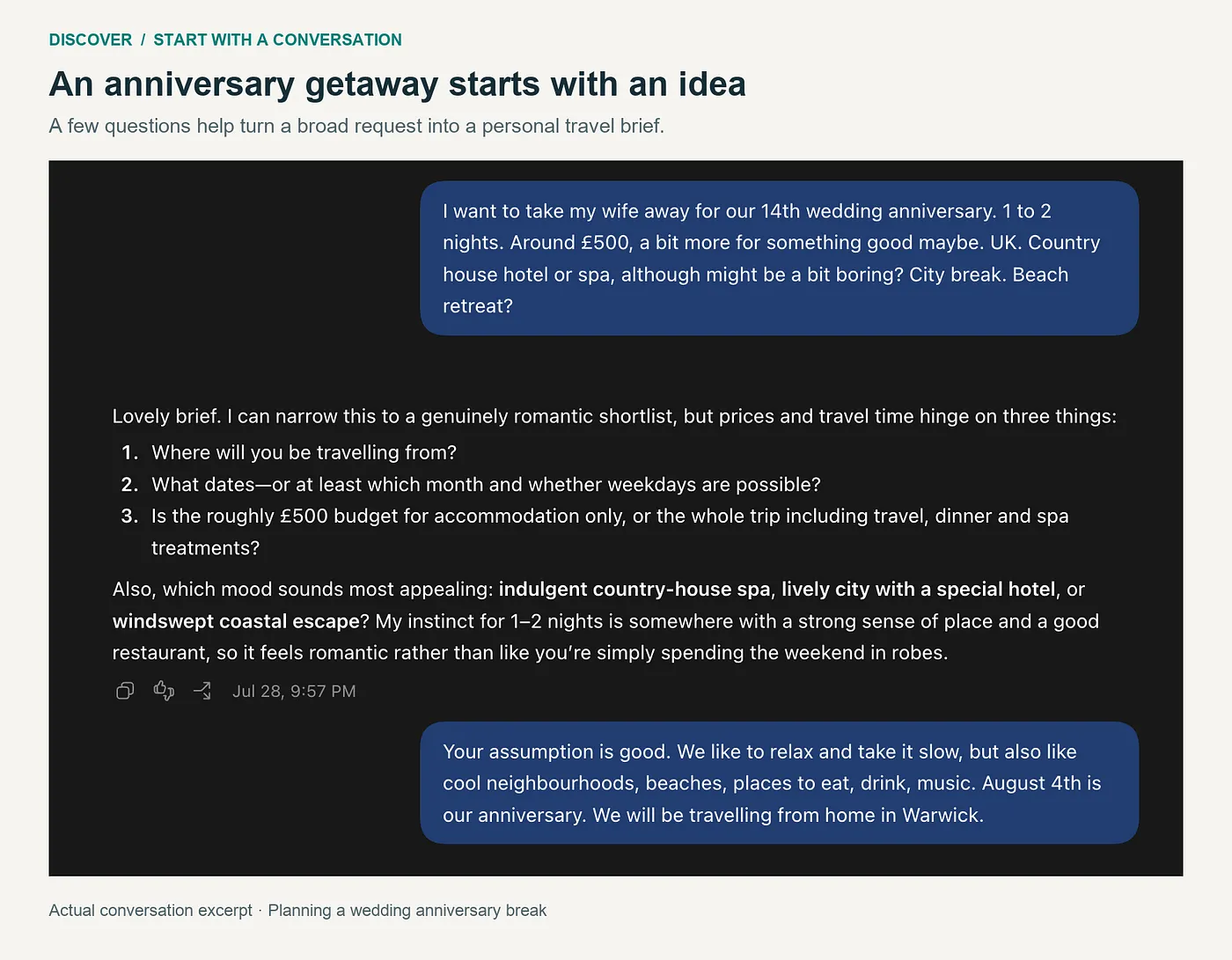
Explain what matters, question a suggestion and refine the plan without starting your research again.

The friction returns when you reach the booking.
In most cases this still means jumping from the AI conversation to a website, re-entering dates, selecting all the extras again, and working through a traditional checkout.
Agentic commerce is about bridging this gap by connecting AI conversation to action.
The buying journey: Discover, Decide, Commit
Right now, AI assistants are useful during discovery. They’re especially good at helping us decide, particularly when there are competing priorities to work through.
But as we move towards commitment, the information requirements change.
A persuasive explanation of why a hotel suits me is useful, but a bookable price must come from the hotel’s actual inventory, rates and terms.
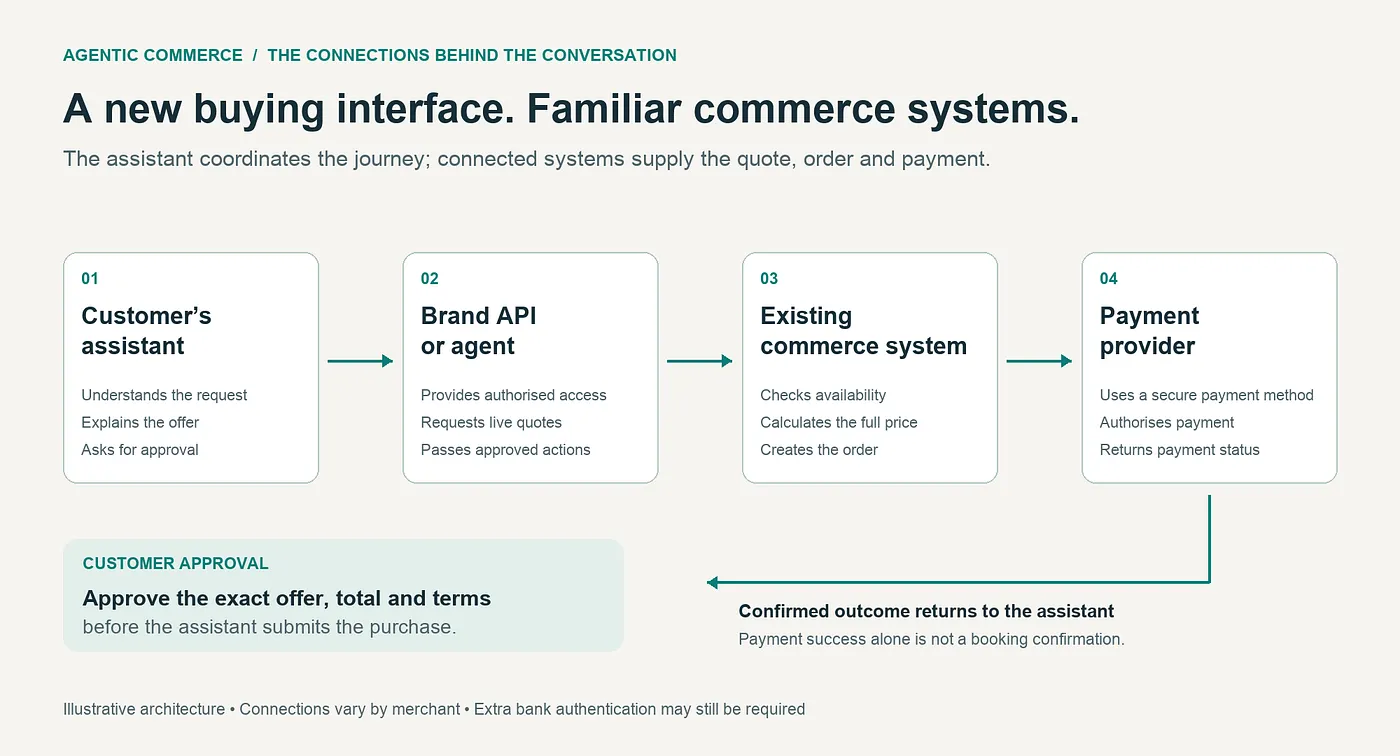
The AI assistant needs dependable connections to the systems that can verify and fulfill the offer.
Why connect the commerce journey with AI?
Three stages of enablement
I expect this challenge to be addressed through three overlapping modes:
1. Assisted buying
The AI assistant researches, compares and prepares the purchase. The customer completes it on the merchant’s website.
This step alone provides a lot of value. The downside is that the final handoff loses context. Customers end up repeating selections or manually checking that the offer still matches what they discussed.
2. Integrated checkout
Discovery and selection happen in the conversation, followed by a secure checkout inside an AI application that supports checkout. The customer enters payment details or chooses a saved payment method and confirms the purchase.
The payment interface handles all the sensitive information, just as it does today, with no card details entering the chat.
Think of a familiar online checkout appearing inside your AI conversation: review the purchase, select a payment method and confirm.
3. Delegated buying
The customer approves a specific offer and the AI assistant completes the purchase through direct commerce and payment connections.
That approval will likely be spoken: “Yes, book that.” Voice makes the interaction convenient, but the underlying requirement is the same: permission to complete the correct transaction, for the agreed amount and terms.
The final big step forward.
Expectations for 2027
These modes will likely coexist across different brands and merchants. My expectation for 2027 is that we’ll see integrated checkout become more common, while delegated buying expands more slowly and selectively.
OpenAI documentation already outlines how embedded checkout and delegated payments can work, although its embedded payment is still limited to beta programmes.
GuestHouse Hotels: the buying journey starts to connect
A recent experience with GuestHouse Hotels brought this shift into focus.
The hotel group uses a booking platform that also integrates with Perplexity, connecting hotel discovery with booking and payment within an AI-led experience. That shows existing booking infrastructure extending into the places where customers are increasingly researching and making decisions.
I wanted to explore how much of the journey my own AI assistant could handle. I asked it to price a stay at №15 Bath: two nights, parking both nights, and breakfast for two each morning.
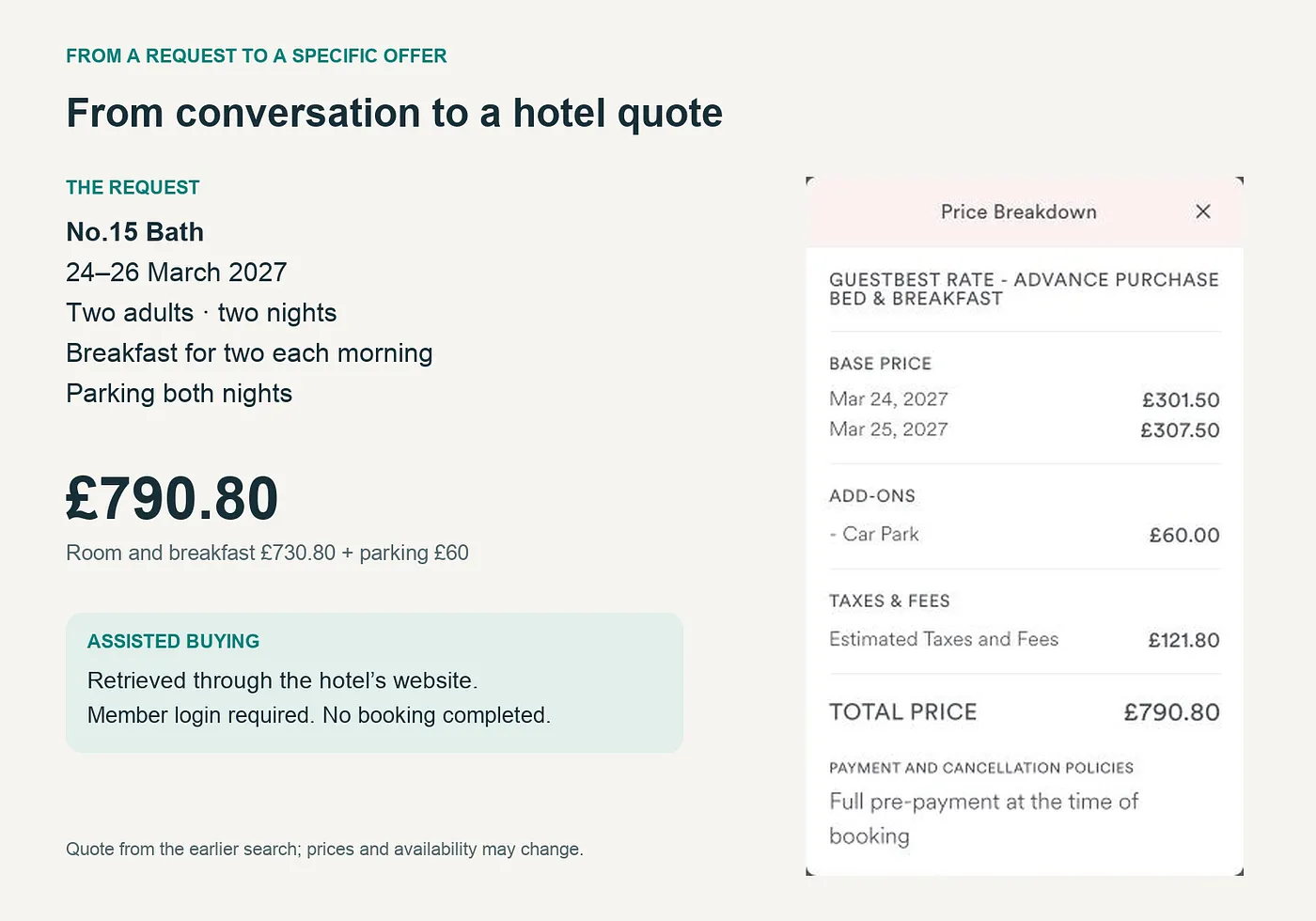
The assistant navigated the hotel’s booking interface, retrieved a live quote and brought the room, package and total back into our conversation. We had moved from Discover to Decide, using current booking information rather than a general recommendation or an indicative price.
This experience demonstrates assisted buying.
The underlying systems can already search availability, price a stay and process a booking. The emerging step is making those capabilities available to customer assistants through supported integrations, so that an approved offer can become a confirmed purchase.
What brands need to do next
The next phase of the buying interface is an AI conversation, and that’s a big leap forward.
Behind it, much of the commerce machinery is familiar. Commerce systems still hold products, calculate prices, manage inventory and create orders. Payment providers still process payments.
The work is making that existing machinery accessible, dependable and authorised for an AI assistant to use:
Dependable content and data.
Product descriptions, inclusions and policies need to agree across all your systems. Current prices and availability should come from authoritative sources inside your core systems.
Connect existing commerce functions.
An API can let an AI assistant request a quote, prepare a basket or reservation, submit an approved purchase and retrieve confirmation. And where those functions already exist in your commerce infrastructure, they can be reused.
Set permissions and approval rules.
Define which actions an AI assistant can take and which need customer approval. Tie approval to the exact order and price, ask again if either changes, and return a clear outcome so the customer knows whether the purchase completed.
Final thought: familiar purchase, new interface
Consumers already search, compare, save payment methods and approve transactions. Agentic commerce brings those familiar activities into one connected experience.
I expect behaviour to change quickly when the experience proves reliable. Trust grows through successful purchases and handling of changes, cancellations and mistakes.
Agents will participate in progressively more of the buying journey. Brands will need to connect them to trusted information and existing commerce systems to serve customers reliably, from discovery to purchase.

Andy Wood, Strategy Partner
20+ years bringing together business strategy, market insight, and technology to deliver business transformation, customer experience innovation and operational efficiency.
I can help you:
• Deliver next-generation digital experiences for customers
• Align enterprise technologies with operational & strategic goals
• Understand AI across business operations & customer experience
Share this

Agentic commerce: from “help me choose” to “go ahead and book it”
The buying journey is becoming a conversation with AI. Connecting it to a completed purchase is the next step.

Beyond AEO: From Answers to Action
AI visibility uses content to help customers find you. The next opportunity is using business knowledge to help their assistants complete the task.

Engineering CMS Platforms for AI Visibility
Structured content, governed workflows and embedded AI for brand visibility at scale.