Imagine three requests made through an AI assistant:
A procurement manager:
“Can you deliver 500 units to our Birmingham plant by Friday, at our contracted price, with the certification this order needs?”
A traveller:
“Move my flight to Friday evening and use my points to cover the difference.”
A parent:
“Am I eligible for help with childcare costs, and can you start my application?”
No web page can answer these. It needs current information, details specific to the person asking, and a way to act.
This depends on two disciplines: data engineering, which makes business knowledge available, and IP management, which sets the terms on which information can be used.
Web page information is limited.
Answer engine optimisation (AEO) helps information appear in direct answers.
It draws on SEO, reflecting the last 30 years of commercial web architecture: organisations publish pages, crawlers discover them, people visit to research, then buy, apply or complete some form of action.
Improving web page sources for AI discovery is a sensible first step.
But the limit is hit when a question needs something more specific than public content can give.
A product page explains what a component does. An airline’s site sets out its change policy. A government page describes who qualifies for social support. But the person asking needs to know what’s available now, what applies to them and whether it can be done by Friday.
Those answers depend on data that changes by the hour, and on details that belong to one customer: a contract, a booking, a household’s circumstances. Even the most frequently updated web page can’t guarantee that an AI assistant has retrieved its latest version.
Public content establishes what an organisation offers.
Connected systems establish what it can do for this person, at this moment.
A web page is only one way to expose information. Inventory systems, product databases, booking platforms, contract records and document repositories all hold knowledge that can determine an AI answer.
Some of that knowledge changes minute by minute. Some is relevant only to a particular customer. Some has commercial value that means it can’t be published on a public web page.
Businesses need AI interfaces that can serve this information selectively, at the moment it’s needed.
From answers to actions.
Today’s customer journey is mostly still organised around people visiting your website.
AI assistants reverse that.
Customers state their goal and it’s the assistant that goes to the organisation on their behalf. It finds options, checks the details and, with access to the right business data and knowledge, can carry out the next action. This might be a purchase, a booking, or an application.
The difference shows in the questions AI assistants are able to answer.
In the table below the left column is AEO/ GEO territory, while the right column is AI-mediated service and commerce:
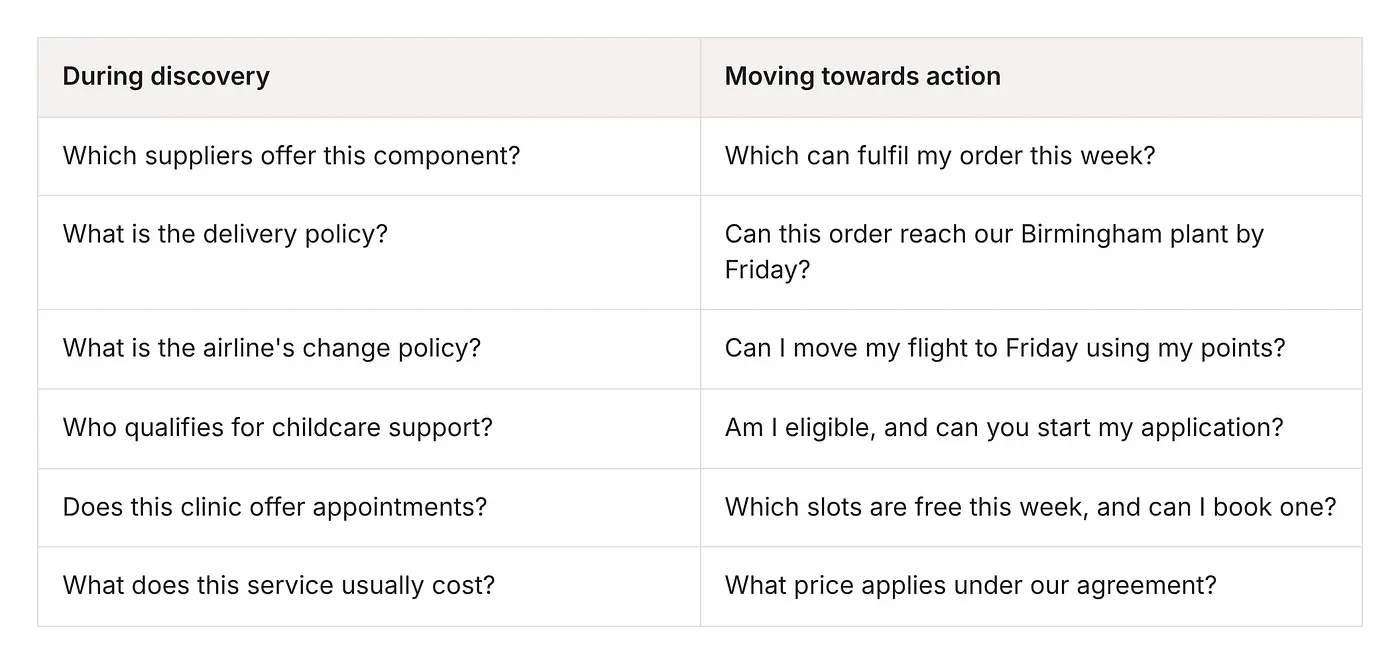
Left is AEO/ GEO territory. Right is AI-mediated service & commerce.
Answering these next action questions means connecting assistants to the systems where knowledge already lives:
Product and service catalogues
Inventory and booking systems
Customer and case records
Websites remain the interface for people. But alongside them, organisations need an interface through which AI systems can request information and perform authorised tasks.
The big opportunity.
Make business knowledge useful to AI assistants at the point of customer decision.
For customers, the payoff is less searching, less repetition and less administration. Their requirements travel with the conversation, from the initial question to an approved next step.
For organisations, it’s an opportunity to respond while someone is ready to act. A supplier can help secure an order, an airline can make a change easier, and a public service can help someone complete an application. Reliable information and easier fulfilment become sources of competitive advantage.
Businesses compete through the quality of their information and the ability to fulfil a request at the moment of customer decision.
The infrastructure is already taking shape.
The infrastructure for assistants to act on someone’s behalf is already taking shape:
Payment providers are building the transaction layer too:
Early first example.
Virgin Atlantic’s new app in ChatGPT gives us a glimpse of how these experiences are starting to work. You can ask about flights in ordinary language with ChatGPT, then explore real-time available flight options.
You still jump to the website to complete the booking, but it brings much more of the discovery journey into the AI conversation, and that’s a useful step toward full AI-mediated commerce.
The next step is to make the airline’s knowledge and services available across all AI assistant chats, so customers can complete the booking inside the assistant chat they’re already using.
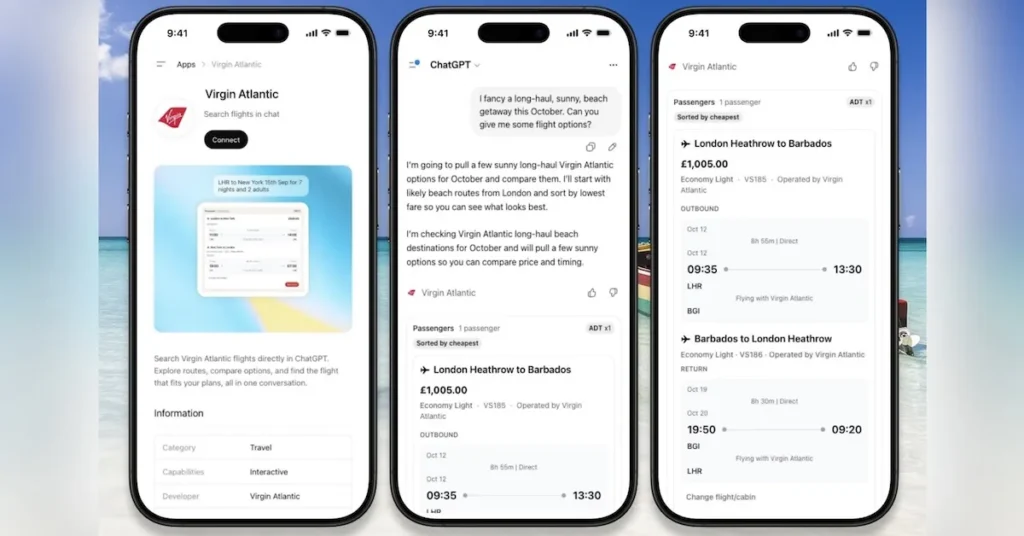
Virgin Atlantic’s new app in ChatGPT is a useful step toward full AI-mediated commerce.